اختر نظام ERP مفتوح المصدر الذي يناسب نموذج التشغيل لديك.
Open-source ERP systems have matured into serious alternatives to proprietary suites costing tens of thousands per year. Odoo, ERPNext, Tryton, Dolibarr, iDempiere and others each carry a different philosophy. The right answer depends on your workflows, scale, technical capacity and long-term ownership goals.
لا يوجد فائز واحد
Each open-source ERP excels in a different context — module breadth, architectural discipline, simplicity, multi-company accounting or distribution depth. Licensing is only one dimension.
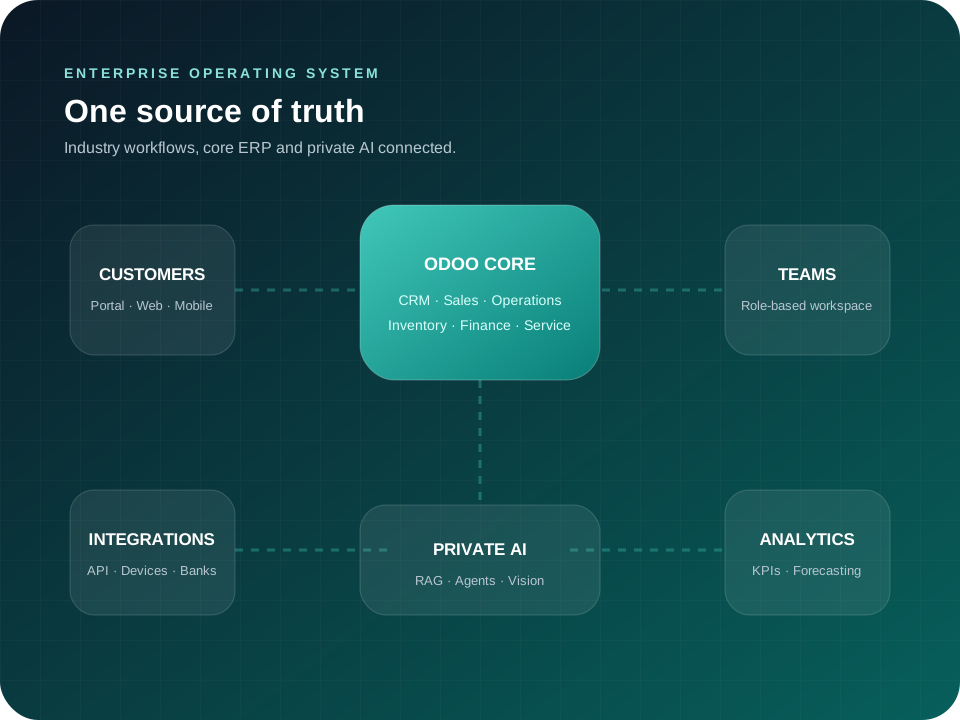
الملكية والسيطرة والتحرر من الاحتكار للمورد.
Open-source ERP systems give businesses full access to the source code — customizable, self-hostable and extendable without recurring license fees or vendor lock-in.
وصول كامل للمصدر
Inspect, modify and extend every layer of the system. No black boxes, no hidden logic, no locked APIs.
السيطرة على النشر
Self-host on your infrastructure, choose your cloud, control your upgrade schedule and data residency.
أنظمة المجتمع البيئية
Thousands of contributors, modules and integrations built by global communities — not a single vendor roadmap.
لا احتكار للمورد
Open licenses mean you own your data, your code and your timeline. Switch integrators without losing your investment.
ستة أنظمة ERP مفتوحة المصدر، ست فلسفات مختلفة.
Each platform was built for a different scale, industry and technical culture. Understanding these differences is the first step to an informed choice.
أودو
The world's most widely adopted open-source ERP, with 12M+ users and 46,000+ community modules. Broadest functional coverage of any open-source platform.
- Broadest module catalog (accounting, CRM, MRP, HR, eCommerce)
- Modern web UI and large partner network
- Dual-license: Enterprise features require paid subscription
Best for: Mid-to-large businesses needing breadth and ecosystem.
ERPNext
The second most popular open-source ERP, built on the Frappe low-code framework. No enterprise tier — the entire codebase is free.
- Fully open-source with no proprietary split
- Low-code customization via Frappe framework
- Smaller ecosystem and partner network than Odoo
Best for: SMBs wanting full ERP without license complexity.
Tryton
Forked from TinyERP, Tryton optimizes for architectural cleanliness and long-term maintainability. No enterprise tier — the entire codebase is free.
- Rigorous modularity — every dependency declared
- Among the strongest accounting engines in open-source
- Smaller community, less marketing, fewer ready modules
Best for: Developers and integrators who value clean code over UX polish.
Dolibarr
A simple ERP/CRM for very small businesses (1-50 employees). The lowest learning curve of any open-source ERP.
- Trivial installation on standard LAMP server
- Lowest learning curve, functional interface
- Limited depth — not suited for complex manufacturing
Best for: Micro-businesses needing CRM, invoicing and basic inventory.
iDempiere
Forked from ADempiere, built on Java with an OSGi plugin model. Genuinely modular at runtime — hot-swap modules without restart.
- Multi-company accounting and complex financial operations
- Metadata-driven UI via Application Dictionary
- Steeper learning curve, smaller community
Best for: Enterprises with multi-entity accounting and complex finances.
Metasfresh
A German open-source ERP focused on wholesale, logistics and distribution-driven businesses.
- Strong distribution, logistics and wholesale depth
- Active codebase with European compliance focus
- Narrower scope — not a general-purpose platform
Best for: Wholesale and distribution businesses in Europe.
قارن مسؤوليات دورة الحياة، وليس فقط شروط الترخيص.
الملاءمة الوظيفية
List required accounting, operations, productivity and industry capabilities. Identify what is standard, third-party or custom in each platform.
البنية المعمارية والمقياس
Match the platform's architecture to your concurrency, multi-company, localization and integration requirements.
المجتمع والنظام البيئي
Assess community size, module availability, partner network and long-term sustainability of each project.
العمليات والترقيات
Estimate the cost of maintaining custom code, testing integrations and moving data across future versions.
أودو Community أو Enterprise — مقارنة موجزة.
When Odoo is the right platform for your operation, the next decision is which edition. Community offers an open-source foundation and strong control. Enterprise adds proprietary applications and vendor services.
قوي حينما تكون السيطرة والأساس المفتوح مهمين.
- Open-source core under LGPLv3 license
- Flexible self-hosting and deployment control
- Suitable foundation for purpose-built industry modules
- Requires a clear plan for missing functions, maintenance and upgrades
Strong when proprietary applications and vendor services fit the requirement.
- Additional proprietary applications and UX features
- Commercial subscription and vendor-backed service options
- Can reduce custom development for covered requirements
- Requires review of subscription, hosting and customization constraints
الحرية تخلق مسؤولية هندسية.
A successful open-source ERP deployment needs disciplined ownership of architecture, security, operations and future upgrades — regardless of which platform you choose.
We compare platforms against your real workflows — not against a preferred vendor.
The objective is not to force one platform. It is to compare open-source ERP systems against required workflows, extensions, operating responsibility and long-term cost.
خريطة المتطلبات
Identify mandatory and optional capabilities by user role and industry.
تحليل فجوات المنصة
Classify standard, community, third-party and custom coverage across platforms.
مقارنة دورة الحياة
Compare delivery, hosting, support, licensing and upgrade responsibility.
أحضر سير العمل المطلوب وقيود النشر.
We will compare open-source ERP platforms against your operation — without hiding extension, support or upgrade responsibilities.