Choose the right intelligence, then build the right infrastructure.
We design AI around the task, the evidence, the response time and the data boundary — then connect it to your ERP without locking your operation to one model or provider.
“Use AI” is not a technical requirement.
A useful system begins with a measurable task: retrieve evidence, extract fields, forecast demand, inspect an image or execute a controlled workflow.
Task fit
A language model, vision model and forecasting model solve different problems. We benchmark candidates on your actual task.
Evidence and control
Retrieval, citations, structured outputs and human approval are designed around the cost of a wrong answer.
Operational fit
Model size is only one variable. Latency, concurrency, context, memory bandwidth and supportability shape the deployment.
Different intelligence for different work.
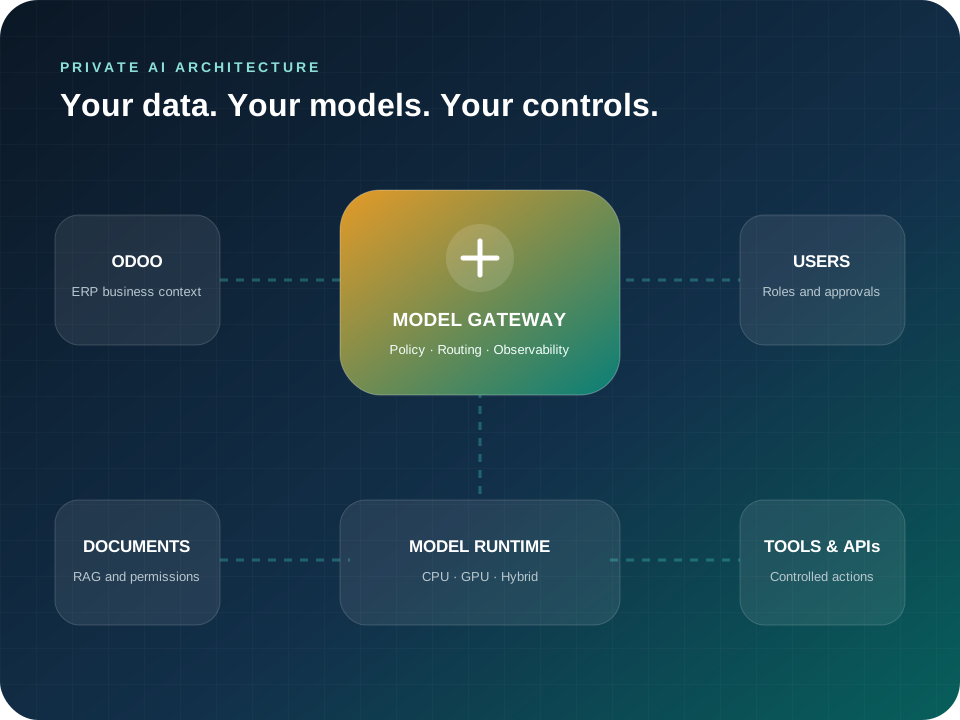
The final architecture can combine more than one model behind a governed gateway instead of forcing every request through one expensive general-purpose model.
Language and reasoning
Assist with analysis, drafting, classification and structured responses.
Enterprise RAG
Retrieve authorized internal evidence before generating an answer, with citations back to source content.
Document intelligence
Classify files and extract verified fields from invoices, contracts, forms, tables and scans.
Computer vision
Detect, classify or inspect visual events at the server, workstation or edge where the workload permits.
Forecasting and scoring
Use time-series or tabular models for demand, risk, anomalies and operational forecasts.
Agents and automation
Let models call approved tools while ERP permissions, business rules and human gates remain in control.
Choose the method after identifying what must change.
Need current, traceable knowledge?
Use retrieval-augmented generation. Keep source documents outside model weights and retrieve evidence at request time.
Consider RAGNeed consistent behavior or format?
Start with prompts and structured outputs. Consider LoRA or QLoRA only after a measured baseline exposes a repeatable gap.
Prompt → PEFTNeed to understand scans or layouts?
Use OCR, document-layout models or a vision-language model, with field-level validation before writing into your ERP.
OCR / VLM / IDPNeed to predict a number?
Compare specialized forecasting and tabular models before selecting an LLM. The simpler model may be faster and easier to evaluate.
Forecasting / MLRAG changes the evidence. Fine-tuning changes the behavior.
They can work together, but they solve different problems. Neither removes the need for evaluation, permissions or human review in high-impact workflows.
Retrieval-Augmented Generation
- Good for changing policies, manuals and operational records.
- Supports citations and document-level permissions.
- Quality depends on parsing, chunking, retrieval and reranking.
LoRA and QLoRA
- Useful for repeatable task behavior, terminology or output style.
- Adds trainable adapters while keeping most base weights frozen.
- Rank, target layers and precision must be selected through experiments.
A model is only “better” against an agreed test.
Dataset size is not a universal threshold. We build a representative evaluation set, measure the baseline and choose the smallest intervention that closes the gap.
Define failure
Agree what a harmful, incomplete or unusable result looks like.
Build examples
Sample real languages, document types, edge cases and user roles.
Benchmark
Compare models, prompts, retrieval settings and output constraints.
Adapt
Tune retrieval or train adapters only where evidence supports it.
Monitor
Track quality, latency, drift, cost and human overrides after release.
Reduce memory carefully, then re-test the task.
Lower precision can reduce model footprint and sometimes improve throughput, but the quality impact is model-, method-, runtime- and workload-dependent.
Candidate runtimes can include llama.cpp/GGUF, OpenVINO, ONNX Runtime, vLLM or other validated engines. Selection follows the model, hardware and throughput target.
Training hardware does not have to dictate production hardware.
A model adapted on GPU may be converted and quantized for CPU inference when the architecture and target runtime support it. Performance must be benchmarked on the exact server.
CPU inference
Can fit low-concurrency assistants, batch extraction and smaller quantized models where latency targets allow.
- Check instruction support and NUMA topology
- Size RAM beyond model weights and KV cache
- Measure memory bandwidth, not cores alone
GPU inference
Preferred when concurrency, first-token latency, long contexts or larger models make acceleration necessary.
- Fit weights and KV cache within usable VRAM
- Benchmark batching and parallelism
- Plan cooling, power and redundancy
Hybrid offload
Some runtimes can split model layers between GPU and system memory when full GPU residency is not practical.
- Validate transfer overhead
- Tune layer placement
- Keep a tested CPU fallback where useful
Size the workload, not a model-name spreadsheet.
Two deployments using the same model may need different hardware because context length, concurrency and response targets change memory and throughput.
Request a sizing assessmentBring one real workload and one real data boundary.
We will turn them into a model shortlist, evaluation plan, integration design and measurable infrastructure test.